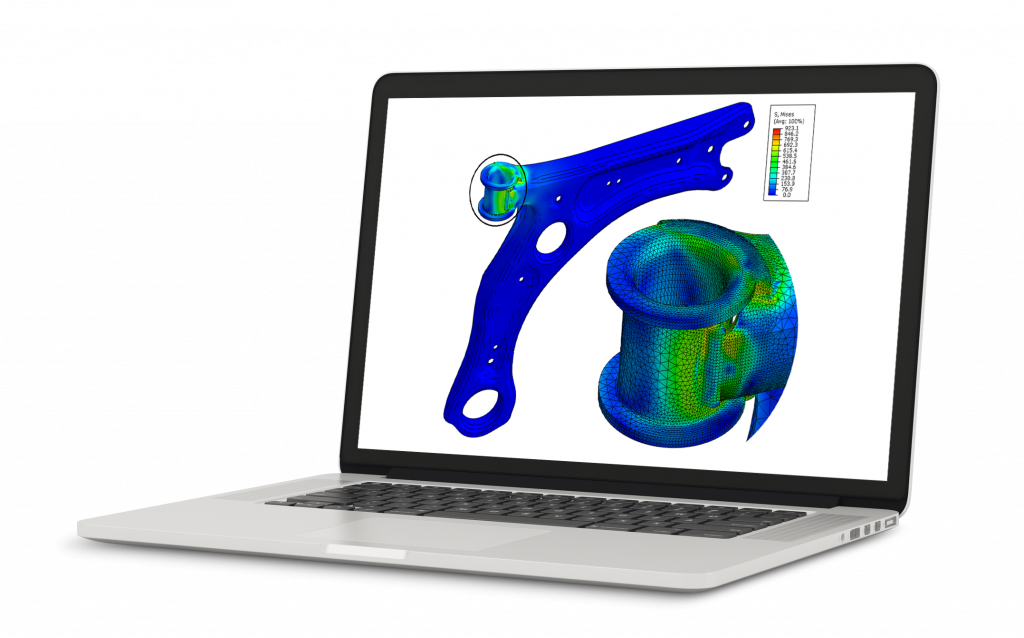
Versatile easy-to-change Finite Element Models (FEM)
Finite element method (FEM) models are widely used tools in fields such as thermal analysis, structural calculation or process simulation. These models are worth highlighting due to their ability to represent complex systems in a simplified way, allowing engineers to analyse physics behaviour under different loading conditions and constraints. The versatility of these models lies in their ability to adapt to different situations and design requirements. Geometry, material properties, loading conditions and constraint types can be easily modified to assess how these changes affect their behaviour. This flexibility is essential to optimise the design of industrial products and processes, and allows multiple iterations and experimentation with different configurations before arriving at the optimal solution. In addition, extreme conditions can be simulated to anticipate possible failures and make preventive improvements. At LORTEK, we have extensive experience in welding process modelling, additive processes, structural calculation and thermal cycle analysis.

Target/Challenge
The aim of FEM models is to support the development and improvement of industrial products and processes.
Result
The combination of FEM models together with in-depth knowledge of processes, materials and testing allows us to study, design and optimise products and processes; minimising the consumption of resources and reducing lead times.
Sectors
 Aeronautics-Aerospace
 Automotive sector
 Components and capital goods
 Digitalisation
 Renewable energy