HIPERION - Generation of knowledge and capabilities for new space technologies and future planetary missions
Participants:
AZTERLAN
CEIT
CIDETEC
CTA
GAIKER
LORTEK
TEKNIKER
UPV/EHU-Departamento de Física Aplicada
Programme:
Sectors:
 Aeronautics-Aerospace
Technologies:
 PBF-LB
Scope
The project "Generation of knowledge and capabilities for new space technologies and future planetary missions - HIPERION” is defined as a tool to boost and promote research into aerospace technology and science, and to support the existing sector fabric in the Basque autonomous community. Space technology and science are characterised by high reliability and low weight requirements in extreme environments, and are spearheading scientific research with downstream applications in fields as diverse as industry, energy, health, and climate change. A knowledge society is based on the process of invention and the development of space technology poses true engineering challenges. Solving those challenges subsequently enables the implementation of the technological solutions found in new everyday applications and broader markets, strengthening Europe's technological competitiveness.
This project focuses on challenges and needs identified by the consortium in the following branches of knowledge and fields of research:
- Advanced manufacturing
- Materials and processes
- Composite materials
- Advanced coatings
- Control systems and avionics systems
Optical path technologies
Solution
LORTEK’s activity as part of the HIPERION project focuses on two different areas: On the one hand, the study of high-strength aluminium alloys (HSAA) that can be processed using PBF-LB technology for hostile environments; And on the other, the design, manufacture and characterisation of new spatial mechanism concepts based on complex lightweight structures.
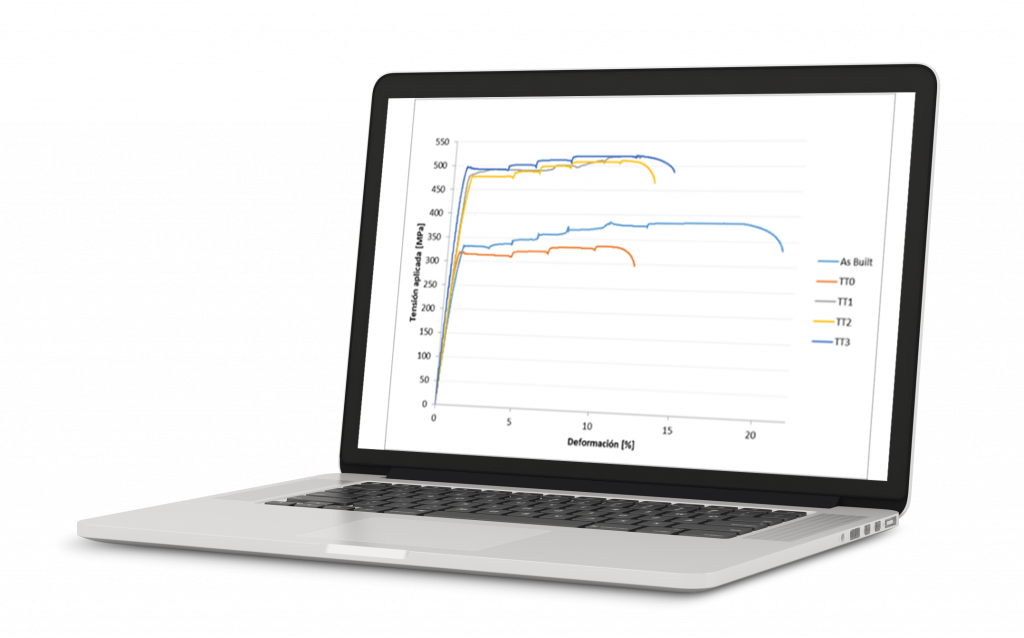
High strength aluminium alloys: HSAA which could be suitable for their application in hostile environments, such as aerospace, have been studied. In particular, Scalmalloy and 7075 aluminium with modified composition to make it processable by PBF-LB have been analysed. For those two materials, the manufacturing process has been optimised, and their microstructure, hardness and mechanical properties have been studied.
New design concepts for aerospace mechanisms: Compliant mechanisms have been designed integrating flexible elements based on grid-lattice structures. The manufacturing process used for this type of structure has been developed and optimised; and they have been characterised by means of advanced mechanical tests using DIC systems.