ALENCO - Development of SLM process for precipitation-hardening alloys for high performance aeronautical components
Participants:
EIPC
LORTEK
Programme:
Sectors:
 Aeronautics-Aerospace
Technologies:
 PBF-LB
Scope
The main aim is to obtain an Additive Manufacturing process for high-performance materials with high potential to replace nickel alloys, which are widely used in aeronautics, and to apply this development to real parts that pose issues when manufactured by conventional technologies such as microfusion. To achieve the overarching aim, specific goals have been defined:
- Obtaining dense parts by optimising PBF-LB process parameters for advanced precipitation hardening alloys;
- Develop specific heat treatments for these alloys to optimise their mechanical properties;
- Adapt the design of conventional parts using DfAM (Design for Additive Manufacturing) design concepts;
- Guarantee the quality of the parts manufactured by PBF-LB during the manufacturing process by means of monitoring systems;
- Validate manufactured parts using destructive and non-destructive inspection techniques.
Additive manufacturing could solve issues related to microfusion manufacturing such as simplifying the manufacture of parts that require additional elements to the usual ones in the process, such as ceramics or soluble wax inserts, simplifying the manufacture of parts that require additional operations while reducing rejects due to dimensional problems associated with part deformation during the microfusion process.
Solution
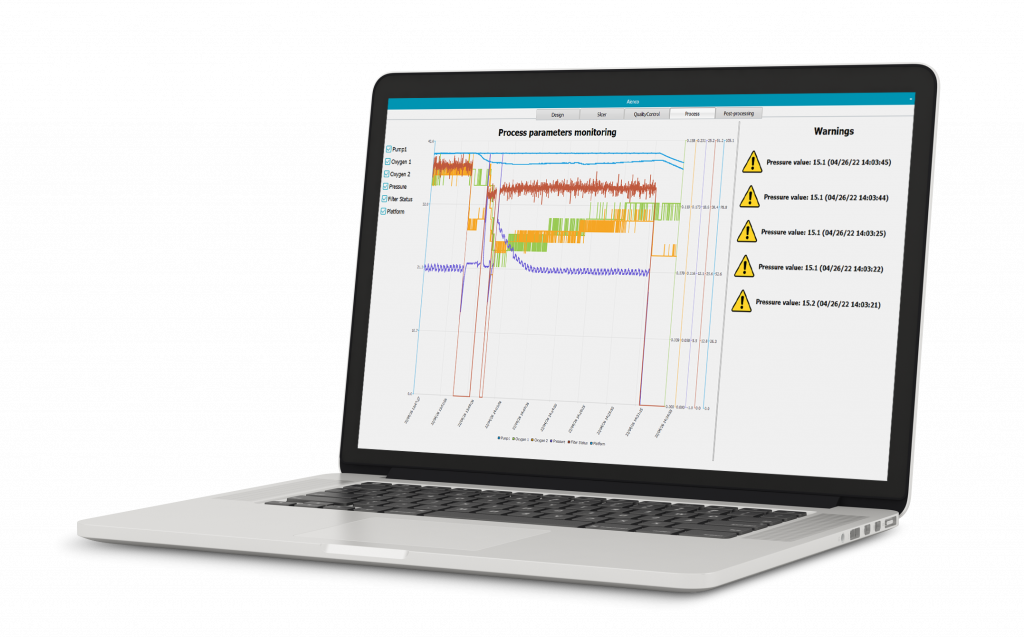
LORTEK has optimised PBF-LB fabrication parameters for 15-5PH precipitation hardening stainless steel by developing a design of experiments (DoE). It is based on the Box-Behnken (BB) response methodology and allows parameter adjustments with a reduced number of experiments, avoiding trial-and-error approaches. Furthermore, specific heat treatments have been defined to guarantee mechanical properties specified in AMS 5400 aeronautical standard with optimised, shorter cycle times, reducing associated costs. Tensile tests have been carried out at room and high temperatures and the resulting microstructure has been analysed under each condition. In addition, an aeronautical part has been redesigned by applying the DfAM concept and maximising lightness with honeycomb structures. The optimised design has been manufactured by PBF-LB with the parameters developed for 15-5PH using monitoring systems to ensure the quality of the component. In particular, the machine parameters that can affect the quality of the part to a greater extent have been monitored, and a safety limit has been defined for the most relevant parameters, so that warnings are triggered if these limits are exceeded. A scanner has been used to verify that the part has no major dimensional deviations and internal defects are minimal through X-rays, dye penetrants and metallography analysis.