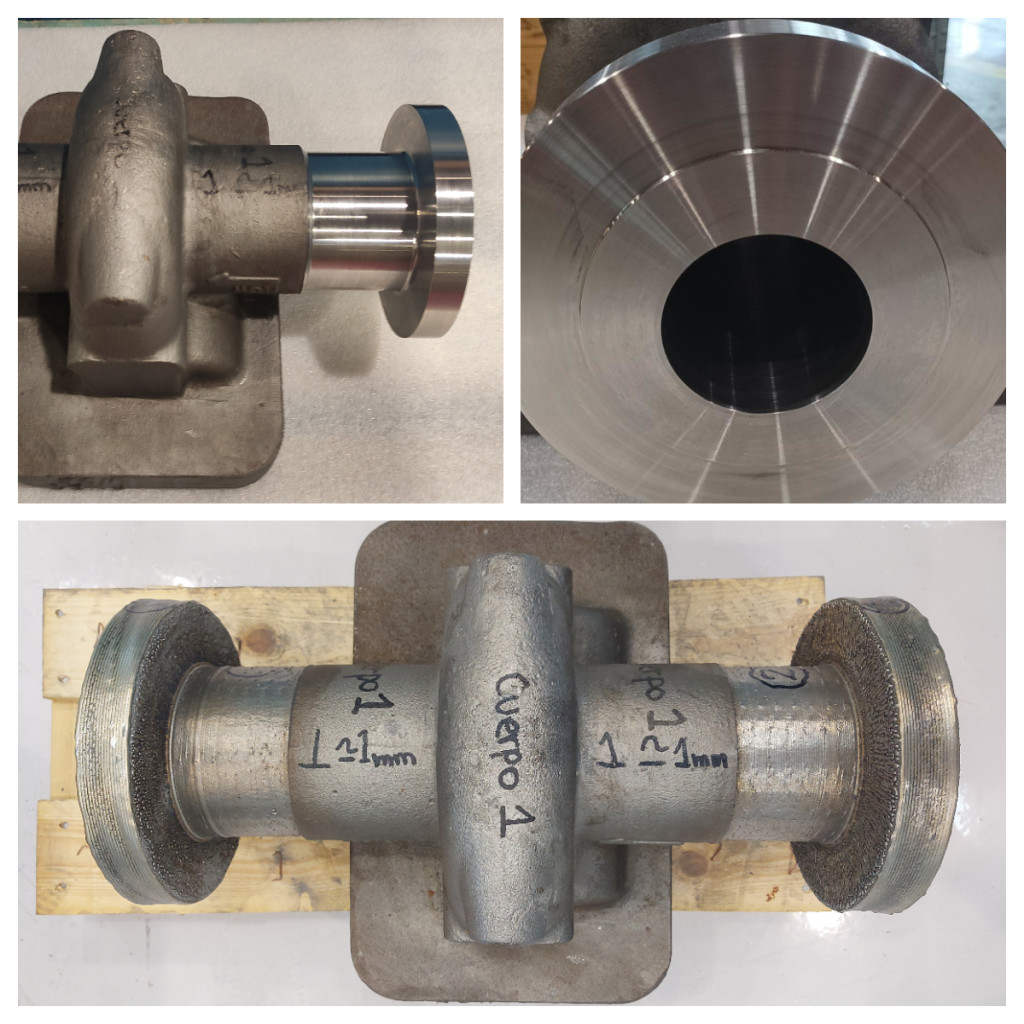
Hybrid Multimaterial Additive Manufacturing DED-LB
Hybrid multimaterial additive manufacturing represents an evolution in advanced manufacturing processes, integrating different technologies to produce optimized industrial components. This approach combines conventional manufacturing (casting, forming, forging, etc.) with additive manufacturing using multimaterial DED-LB and CNC machining. As a result, components with enhanced properties, new functionalities, or adaptations to specific sector, application, or product requirements can be obtained.
This technology focuses on the use of commercially available and compatible materials, ensuring process feasibility and repeatability in production. The development of this solution has enabled the validation of both the manufacturing method and the materials used, complying with applicable standards and regulations in demanding industrial sectors.
The use of hybrid multimaterial additive manufacturing facilitates the production of components with different types of metallic alloys, adding functionality or production flexibility within a single structure. This optimizes performance without the need for additional assemblies. Furthermore, integrating multiple materials into a single component significantly improves mechanical strength, durability, and performance in demanding operational environments. At the same time, it reduces costs by avoiding the use of an expensive material throughout the entire part, applying it only where required.

Target/Challenge
This solution is aimed at sectors such as energy, oil & gas, and petrochemicals, where components with high mechanical strength, durability, and material optimization are required. The goal is to develop an advanced, qualified, and validated manufacturing process, ensuring reliability and compliance with the sector's strict regulations.
Result
- Greater production efficiency, combining hybrid manufacturing technologies to optimize the process.
- Design flexibility, allowing the production of complex geometries without the need for molds or minimum production quantities.
- Material optimization, ensuring compatibility and performance improvements, with preforms close to the final geometry.
- Cost and lead time reduction, eliminating dependency on cast preforms and waiting times in the traditional supply chain.
- Longer component lifespan, achieved by integrating materials with specific properties for each function, extending service life without compromising mechanical and microstructural performance.
Sectors
 Renewable energy
 Oil&Gas